Website Development Cost in India (2026): A Transparent Price Guide
What does a website really cost in India? Clear price ranges for business, ecommerce and custom websites, what drives the cost, th...
Read article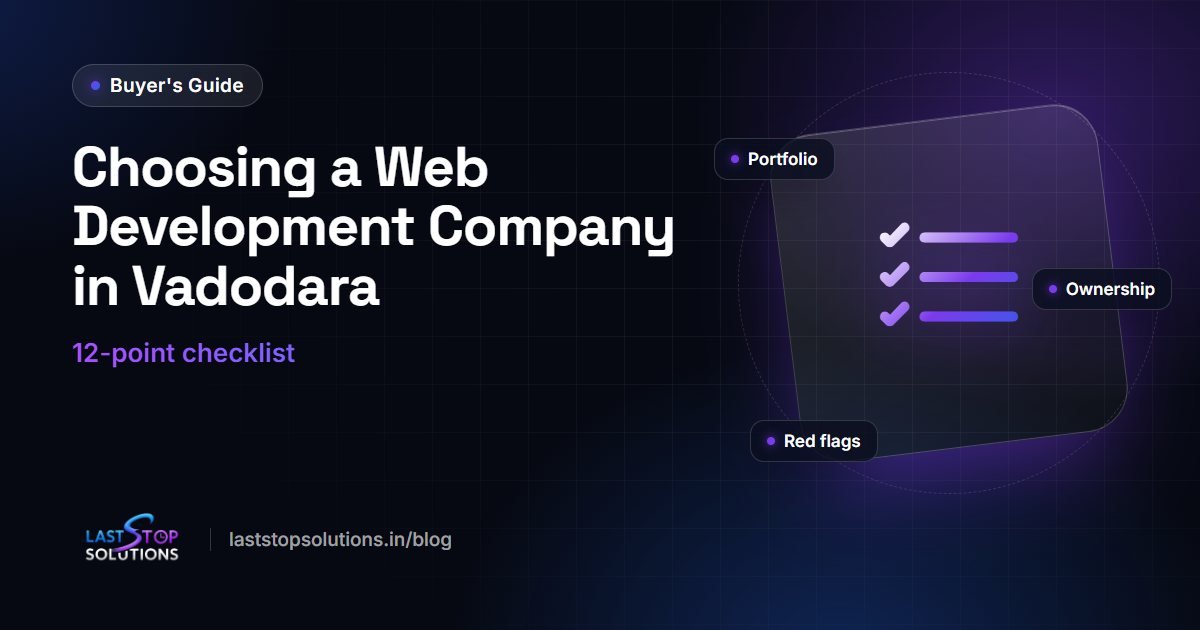
Quick answer: Choose a website development company by checking live sites they built (on your phone), confirming they've built something similar, meeting the people who'll do the work, and getting an itemised, fixed-scope quote. Make sure the domain, hosting and source code end up in your name. The cheapest quote is rarely the cheapest outcome.
Vadodara has hundreds of web development companies, from one-person studios to large IT firms. Most have attractive websites and similar promises, so comparing them is genuinely hard. A poor choice usually doesn't show up until months later — as a slow site, no Google traffic, a developer who has stopped replying, or a rebuild that costs more than the original project.
This checklist is what we would tell a friend who is hiring an agency — even if that agency isn't us.
Ask for links to three recent projects and open them on your phone, not a laptop. Do they load quickly? Is the text readable? Do the forms work? Run them through Google PageSpeed Insights — a portfolio full of slow sites tells you what yours will be like.
An agency that builds beautiful restaurant websites may not be the right choice for a B2B manufacturer that needs product catalogues and RFQ forms. Ask specifically about projects in your industry or with the features you need.
The person who sells the project is often not the person who builds it. Ask who your designer and developer will be and who your day-to-day contact is. Smaller teams often give you direct access to the people doing the work, which speeds everything up.
Good answers mention page titles and descriptions, clean URLs, schema markup, an XML sitemap, Search Console setup, image optimisation and site speed. Vague promises of "SEO-friendly design" or "guaranteed first page" are red flags.
Your domain and hosting should be registered in your company's name, and you should receive the source code and admin logins at handover. If an agency refuses, walk away — you are renting, not buying.
A one-line "website — ₹60,000" quote makes it impossible to compare offers or control scope. A good proposal lists pages, features, integrations, content responsibilities, revisions, timeline and what happens if requirements change.
Ask how the project runs: discovery, wireframes, design approval, development, testing, launch. When do you see progress? A staging link you can visit during development is a good sign. Payments tied to milestones (for example 40/40/20) protect both sides.
Ask for a demo of how you'll edit text, add blog posts and view enquiries. If every small change requires the agency, you'll pay for it for years.
Most of your visitors will use mid-range Android phones on mobile data, not the latest iPhone on office Wi-Fi. A site that feels fast on a ₹15,000 phone will feel fast everywhere.
Who updates the software? How often are backups taken, and where are they stored? Are forms protected against spam bots? A hacked site can damage your Google rankings for months.
Is there a free support period after launch? What does an annual maintenance contract (AMC) cost and include? How quickly do they respond to urgent issues? Get it in writing.
Read the agency's Google reviews — especially how they respond to negative ones. If possible, call one past client and ask a simple question: "Would you hire them again?"
You can work well with a good agency anywhere in India. But a local partner has real advantages: you can meet in person for the kickoff and design reviews, communicate in Gujarati or Hindi if you prefer, and visit their office to see the team behind the website. Local agencies also tend to understand the regional market, competitors and customers better.
What matters most is fit — similar projects, clear communication and honest pricing. Location is a tie-breaker, not the main criterion.
For a professional business website, most established Vadodara agencies charge between ₹25,000 and ₹1,20,000 excluding GST, depending on design, content and features. Ecommerce and custom web applications cost more. Freelancers are cheaper but carry more risk around availability and support.
Typically 2–6 weeks for a business website and 4–10 weeks for an ecommerce store. The timeline depends heavily on how quickly content and feedback are provided by the client.
WordPress is a good fit for content-heavy marketing sites with standard features. A custom website suits businesses that need unique functionality, tight integration with other systems, or maximum speed and security. A good agency will recommend one based on your needs, not their habits.
The scope (pages and features), timeline and milestones, payment schedule, number of revisions, content responsibilities, ownership of code and accounts, support period after launch, and how change requests are priced.
Looking for a website partner in Vadodara? We're happy to answer these 12 questions for you in person or on a call. See how we build websites or ask for a free, itemised estimate below.

Last Stop Solutions is a software and digital agency in Vadodara that builds websites, apps, ERP, CRM and automation for growing Indian businesses. We write about what we see in real projects — costs, trade-offs and what actually works.
No comments yet — questions are welcome, we answer every one.
Tell us what you need. A senior team member replies within 24 hours with a clear plan, timeline and itemised estimate — no obligation, no sales pressure.
What does a website really cost in India? Clear price ranges for business, ecommerce and custom websites, what drives the cost, th...
Read articlePlanning an online store? Compare the real costs of Shopify, WooCommerce and custom ecommerce in India — setup, monthly fees, paym...
Read articleFrom simple apps to marketplaces: realistic app development costs in India, what drives them, Flutter vs native, costs after launc...
Read articleTell us what you want to build and we'll send a detailed, itemised estimate within 24 hours. No obligation.